
Your SAP quote doesn’t answer some important budget questions. Subscription fees do not always reflect the extent of implementation and ongoing commitment. Many business organizations calculate the costs of SAP ERP by multiplying the number of employees by a monthly user cost. But it doesn’t account for any entitlement categories, migration scope, integration efforts, or in-house employees.
Finance leaders require similar data, and architects require unambiguous technical assumptions on which they are based. SAP ECC customers have to make decisions on maintenance, too, which can impact their transition budgets. This article describes the components of total expenditure and how deployment, licensing, and support obligations affect it. It distinguishes the charges that come from a contract from those that are assumed in the project and offers an example of a three-year budget. Apply it to make comparisons between proposals with the same business scope and operating requirements.
SAP ERP costs include software fees, implementation, integration, migration, and maintenance. The software component is dependent on your edition, licensed use, business scope, and contract. Make comparisons of full proposals over a common timeframe. The public estimate per user is not a substitute for a quotation detailing entitlements, technical services, customer responsibilities, and renewal terms.
What Is SAP ERP Cost?
The total amount of money needed to license, deploy, run, and support an SAP enterprise resource planning (ERP) solution is SAP ERP cost. It involves the effort of the vendor, the effort of the partners, and the effort of the customers. A useful estimate is for the project and also for recurring operations.
Total cost of ownership, commonly referred to as TCO, offers the ‘big picture’ budgeting perspective. This consists of subscription renewals, support staffing, integration operations, testing, and future changes. So make comparisons over the same three-year (or five-year) span.
Define the Product Before Comparing Prices
Before comparing totals, make sure to separate out committed charges from assumptions. Determine the contractual quantities of costs and the costs dependent on delivery effort. Otherwise, one may be able to get a lower quotation that another supplier may not.
Before checking prices, make sure to define the product and understand the features.
SAP Business One and SAP S/4HANA solve different needs, implementation strategies, and operating environments. SAP ECC is an already installed base that has its own contracts and maintenance roles. Using them as an equivalent price level can lead to false comparisons.
Define legal entities, countries, processes, reporting requirements, and deployment before quoting. Also identify the SAP applications that are not planned to be incorporated in the proposed ERP. You may also need other products for procurement, payroll, industry-specific functions, and analytics.
How Does Deployment Change SAP ERP Pricing?
Deployment changes how you purchase software and divide operating responsibilities. Cloud subscriptions cover defined services, while on-premise arrangements separate more software and infrastructure costs. Public Edition and Private Edition also differ, so compare their scope before comparing their contract totals.
SAP distinguishes Public Edition, Private Edition, and on-premise SAP S/4HANA as separate offerings. Their characteristics and upgrade arrangements differ. Those differences affect implementation planning and ongoing customer work.
| Offering | Commercial basis to confirm | Main budgeting question |
| SAP Business One | Partner quotation; license or subscription arrangement | What do hosting, implementation, and add-ons include? |
| SAP S/4HANA Cloud Public Edition | Subscription and applicable usage entitlements | Does standard scope cover the required processes? |
| SAP S/4HANA Cloud Private Edition | Subscription with defined technical services | Which application and operating tasks remain customer responsibilities? |
| On-premise SAP S/4HANA | Software contract, maintenance, and infrastructure | What will infrastructure, technical operations, and upgrades cost? |
| Existing SAP ECC | Installed entitlements and maintenance agreement | What will continued operation and transition require? |
Public Edition and Private Edition Need Separate Budgets
Public Edition budgeting should test whether standard processes satisfy the business requirement. Process gaps can create extension, integration, and change-management work. A subscription comparison alone will not reveal those delivery costs.
Private Edition budgeting should identify the existing application footprint and retained complexity. Custom programs, interfaces, and business configurations can create substantial testing requirements. Hosting the application elsewhere does not automatically remove that work.
Use the SAP offering comparison to establish deployment differences. Then request a responsibility schedule covering operations, application changes, testing, and incident handling. See how 15 real companies use SAP ERP to manage their business operations.
Why Is a Per-User Price Insufficient?
A per-user price is insufficient because employees do not necessarily require identical licensed usage. Contract metrics, access categories, and additional entitlements affect subscription quantities. First map business roles to permitted activities, then ask SAP to validate the proposed commercial calculation.
Full Use Equivalent, or FUE, metrics appear in SAP cloud service descriptions. Applicable usage packages determine how licensed quantities relate to access requirements. Avoid treating every employee as one interchangeable subscription unit.
Map Roles Before Calculating Subscription Quantities
Start with business activities rather than job titles. A finance specialist, occasional approver, and warehouse operator may need different access. Document their required transactions, applications, and responsibilities before calculating quantities.
Then validate the role design against the applicable service description and order form. Record assumptions about workforce growth, temporary staff, and external access. Otherwise, the approved budget may understate the quantities required after deployment.
Additional applications and services also need separate entitlement checks. Do not assume that an ERP subscription covers every integration or extension requirement. Confirm included services, consumption limits, and additional purchases within the quotation.
What makes SAP ERP implementation cost?
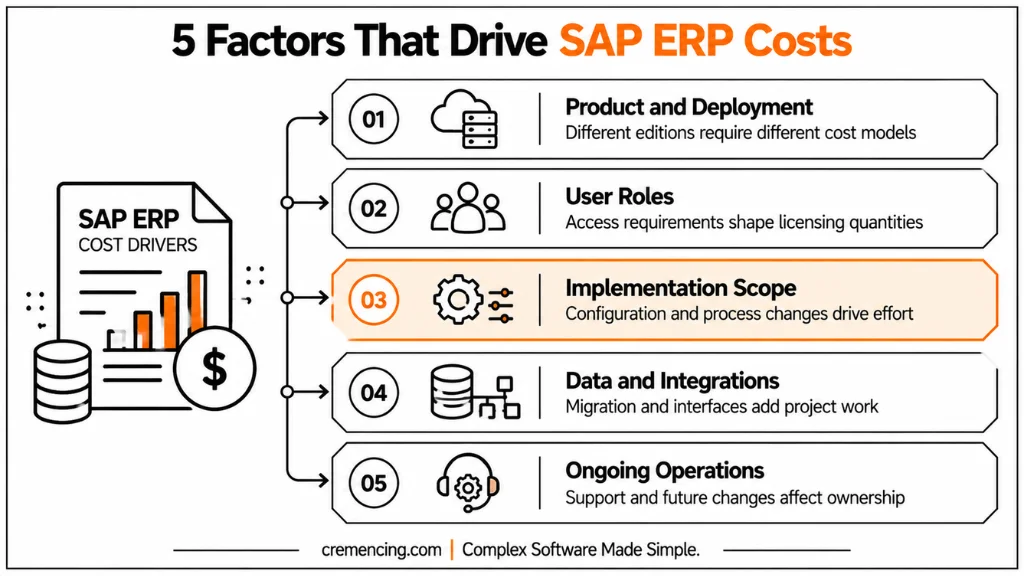
The cost of SAP ERP implementation is dependent on the amount of work needed to provide a usable business process. Effort depends on configuration, migration, integration, extension, testing, and adoption. These work packages do not need to be multiplied by an unexplained multiplier to the value of the software subscription or license.
There’s no single meaningful benchmark for a narrow implementation and a multinational transformation. Delivery is impacted by country requirements, differences in processes, and readiness of organizations. As such, estimates from suppliers must be clearly defined in scope and with acceptance criteria.
Configuration and Process Decisions
The more varied the business units’ processes, the more effort that goes into configuration. Business decisions are needed with regard to procurement approvals, financial controls, inventory policies, and reporting structures. Even though the software is working correctly, delayed decisions can lengthen the consulting effort.
Set up process owners before workshops. Get their approval for the requirements, exceptions, and acceptance criteria. This decreases the need for repeated design discussions and will result in more cost-effective scope changes.
Migration and Reconciliation
Migration isn’t just about uploading records to a new application. Business data needs to be extracted, cleansed, mapped, loaded, and reconciled by teams. They also require owners who have the authorization to approve the finalized balances and records.
Identify the master data, open transactions, and historical data to be moved. You may have to use different validation rules for customer records than for outstanding receivables, for instance. Do budgeted trial loads and financial reconciliation prior to the production cutover.
Extensions and Future Change
Custom functionality creates costs beyond initial development. Teams must test extensions, document them, and support changes after deployment. Therefore, evaluate the operating impact alongside the immediate business requirement.
Extensions on SAP Business Technology Platform may introduce separate services and consumption charges. They also require deployment, monitoring, and support arrangements. Compare those costs with the relevant in-application extension approach before approving the design.
How Do Integrations Increase the Budget?
Integrations increase the budget through design, development, testing, and production support. Each interface needs clear data ownership, security, and failure handling. Estimate its complete lifecycle rather than counting connections or assuming middleware charges cover the delivery work required for each connection.
Application programming interfaces, or APIs, carry data between applications. However, selecting an API does not resolve mapping, reconciliation, or operational ownership. Those engineering decisions affect both project effort and recurring support.
Follow a Transaction Across the Boundary
Consider an external ordering application that creates sales orders in SAP S/4HANA. The design must map customers, products, quantities, and commercial references. It must also handle rejected requests and unexpected response failures.
If SAP accepts an order but the response disappears, an immediate retry may create another order. Duplicate prevention needs an agreed design and test cases. Budget that works alongside authentication, monitoring, and reconciliation.
Price the Operating Model
Identify who investigates failed messages and who corrects business data. Specify alert routing, response expectations, and access requirements. These responsibilities determine the support effort after the interface goes live.
Count interfaces by complexity rather than treating every connection equally. A daily reference-data transfer differs from a time-sensitive transaction with recovery requirements. Include external supplier coordination and end-to-end testing in each estimate.
What Should a Three-Year SAP ERP Budget Include?
A three-year SAP ERP budget should include software, implementation, integration, customer effort, and ongoing support. It should also identify exclusions and uncertainty. Use quoted amounts where available, and label every planning assumption so reviewers can distinguish committed charges from estimates.
The following example uses invented planning inputs in United States dollars, or USD. It represents a hypothetical organization comparing a cloud proposal. These figures illustrate budgeting arithmetic; they do not establish SAP market prices.
| Cost component | Illustrative assumption | Three-year amount, USD |
| ERP subscription | $120,000 annually | $360,000 |
| Implementation and configuration | One-time estimate | $180,000 |
| Migration and reconciliation | Separate project allowance | $45,000 |
| Integration delivery | Separate project allowance | $60,000 |
| Training and internal backfill | Separate project allowance | $40,000 |
| Application and integration support | $30,000 annually | $90,000 |
| Subtotal | Before contingency | $775,000 |
| Project contingency | 15% of $325,000 one-time work | $48,750 |
| Illustrative total | Before stated exclusions | $823,750 |
Check the Assumptions Behind the Total
The subscription contributes $360,000 across three years. One-time project work contributes $325,000, while recurring support contributes $90,000. The contingency applies only to the one-time project allowance.
The example excludes taxes, inflation, exchange-rate changes, and additional business applications. It also assumes the subscription begins at the start of the period. Replace these assumptions with the proposed contract and delivery schedule.
Avoid double counting services across subscription and partner proposals. Migration, training, or support may already appear inside another work package. Require suppliers to identify inclusions before combining their figures.
How Does ECC Maintenance Affect Transition Costs?
ECC maintenance affects transition costs when eligible systems require support beyond their mainstream maintenance period. Optional extended maintenance adds a premium to the applicable maintenance basis. Budget this alongside migration work, and confirm the installed release before assuming eligibility or dates.
SAP’s published strategy covers eligible SAP Business Suite 7 core applications through the end of 2027. It includes the latest three enhancement packages of SAP ERP 6.0. Optional extended maintenance runs from 2028 through 2030.
Calculate the Premium Correctly
SAP specifies a two-percentage-point premium on the applicable maintenance basis. This is different from increasing the existing maintenance invoice by 2%. Confirm the maintenance basis and support terms before calculating the amount.
For illustration, assume a $10 million maintenance basis and a contractual 22% rate. Annual maintenance would equal $2.2 million. Adding two percentage points produces $2.4 million, an increase of $200,000.
The example does not establish a universal contractual rate. Actual charges depend on the agreement and eligible software scope. Review the SAP maintenance strategy before finalizing the transition budget.
Account for Options Beyond Extended Maintenance
SAP also identifies customer-specific maintenance after mainstream or extended maintenance ends. Its scope requires separate assessment. Third-party support proposals likewise need careful review of contractual rights, coverage, and operational implications.SAP has announced an SAP ERP private edition transition option for continuity from 2031 through 2033.
This time-bound subscription offering has specific conditions. Treat it as a distinct transition proposal, rather than a blanket ECC maintenance extension.
How Can You Reduce SAP ERP Cost?
You can reduce SAP ERP cost by clarifying scope, validating entitlements, and controlling technical complexity. Compare complete proposals before negotiating individual prices. Also test migration readiness and support responsibilities early, because unresolved delivery assumptions can create costs after the commercial agreement.
Use Assessment Evidence Before Negotiation
Existing ECC customers should assess their application and data footprint before fixing the migration budget. SAP Readiness Check provides analysis relevant to transition planning. Use its findings to guide further investigation and estimates.
Ask suppliers to connect estimates to identified work packages. Separate confirmed requirements from unresolved assumptions. Assessment outputs inform planning, but they do not replace detailed design or a delivery estimate.
Negotiate Quantities and Responsibilities Together
Removing unnecessary access may reduce future entitlement needs. However, identifying unused licenses does not automatically reduce an existing maintenance obligation. Confirm contractual rights to reduce before recording savings in the business case.
Negotiate renewal provisions, quantity adjustments, exit assistance, and rates for additional services. Also define who performs testing and supports extensions. A favorable software price cannot compensate for unclear delivery responsibilities.
Conclusion
SAP ERP cost reflects commercial terms, technical scope, and operating responsibilities across the application lifecycle. A credible budget separates software charges from implementation, migration, integration, and customer effort. It also identifies the assumptions behind each amount. Per-user estimates can support an initial discussion, but they cannot replace validated entitlements and comparable supplier proposals. Architecture decisions matter because extensions, interfaces, and process exceptions create continuing work.
Existing ECC customers must also connect maintenance choices with realistic transition dates. Eligible extended maintenance and other transition arrangements require separate scope and contract checks. Cloud proposals deserve the same scrutiny around included services, renewals, testing, and support. Request two proposals against one agreed scope, then compare their complete five-year costs and responsibilities.
Frequently Asked Questions
How much does SAP ERP cost?
SAP ERP cost depends on the product, licensed usage, implementation scope, and operating requirements. Request a written quotation rather than treating public per-user figures as universal prices. For meaningful comparisons, include migration, integration, training, customer staffing, and recurring support across the same budgeting period.
How much does SAP S/4HANA cost per user?
SAP S/4HANA pricing depends on the offering and applicable contractual metrics. Cloud agreements can use usage categories and Full Use Equivalent calculations rather than identical employee subscriptions. Map required business activities first, then ask SAP to validate quantities, included services, and the proposed commercial calculation.
What is the SAP ERP price for small businesses?
The SAP ERP price for a small business requires a product-specific quotation. SAP Business One may suit some requirements, while other organizations need broader process coverage. Compare implementation, hosting, integrations, add-ons, and support alongside software charges before choosing based on employee count alone.
How much does SAP ECC maintenance cost per year?
SAP ECC maintenance cost follows the customer’s agreement and applicable maintenance basis. Eligible extended maintenance from 2028 through 2030 adds two percentage points to that basis. Confirm release eligibility, contracted support terms, and covered software before calculating the charge or comparing alternative support arrangements.
Why is SAP implementation expensive?
SAP implementation requires coordinated configuration, migration, integration, testing, and business adoption. Complex processes and poor source data can increase delivery effort. Estimate each work package separately, assign business owners, and define acceptance criteria rather than assuming a fixed relationship between implementation costs and software charges.
Is cloud SAP ERP cheaper than on-premise?
Cloud SAP ERP can reduce some upfront infrastructure requirements, but total cost depends on the contract and operating model. Subscriptions do not remove all testing, extensions, or application-support work. Compare equivalent functionality and responsibilities over several years, including renewals, infrastructure, customer staffing, and change effort.
Does SAP ERP pricing include support?
SAP ERP pricing includes only the support services defined in the applicable agreement. Cloud proposals may cover vendor support and specified technical services, while customer application work remains separate. Check incident handling, integrations, extensions, testing, and partner support before assuming one subscription covers every responsibility.
How can I lower my SAP ERP system price?
Lower your SAP ERP system price by validating required entitlements and negotiating against a clearly defined scope. Reduce unnecessary process exceptions and price integration work explicitly. Confirm renewal terms and quantity adjustment rights, then distinguish contractual savings from assumptions about lower implementation or support effort.