

Introduction
Every company moving to SAP S/4HANA needs developers who can turn standard capabilities into solutions that fit the business. That is where ABAP development comes in. ABAP is no longer just the language behind classic reports and custom programs. On S/4HANA it works with SAP HANA, Core Data Services (CDS), and the ABAP RESTful Application Programming Model (RAP), so developers can build fast, upgrade-safe, cloud-ready applications.
This guide covers what ABAP development for SAP S/4HANA involves, how ABAP on HANA improves performance, and which skills and best practices matter most. Whether you are starting your SAP career or updating your existing ABAP skills, you will see why this language remains central to enterprise development.
Understanding ABAP Development
What Is ABAP?
SAP ABAP (Advanced Business Application Programming) is a high-level programming language used to develop SAP applications and business processes. Now that SAP S/4HANA has arrived, you need to be fluent in both the how and the why of ABAP optimization.
The Role of SAP HANA
SAP HANA is the in-memory database platform that improves business processes and offers real-time analytics and transaction processing. Therefore, connecting ABAP to SAP HANA opens up a new level of performance optimization. In particular, you can write ABAP code that pushes data-intensive logic from the application server down to the database, where it belongs.
How ABAP Has Evolved with the SAP Landscape
ABAP’s journey alongside SAP has been truly extraordinary. Originally, the language was intended for reporting and business applications. Over time, however, it has grown to support cutting-edge digital innovation. With SAP S/4HANA, ABAP is no longer just procedural programming. Instead, it combines object-oriented thinking, modern syntax, and interfaces to new technologies. As a result, developers can create future-ready, scalable solutions that support industry-wide digital transformation plans.
Integration Opportunities with Emerging Technologies
With S/4HANA, ABAP lets developers integrate applications with AI services, machine learning models, IoT sensors, and robotic process automation (RPA). Consequently, companies can extend their ERP capabilities and become intelligent enterprises. For example, a team could combine IoT data streams with ABAP logic to build predictive maintenance solutions. In turn, these solutions reduce downtime and optimize resources
Significance of Extensibility in S/4HANA Development
Integrating extensibility into S/4HANA is critical, and the ABAP developer is pivotal to making it real. Rather than tailoring the standard SAP codebase extensively, it is recommended to leverage extension mechanisms like the ABAP RESTful Programming Model (RAP), user exits, and CDS views. This ensures system stability during upgrades and lowers long-term maintenance costs.
Building a Future-Ready Developer Skillset
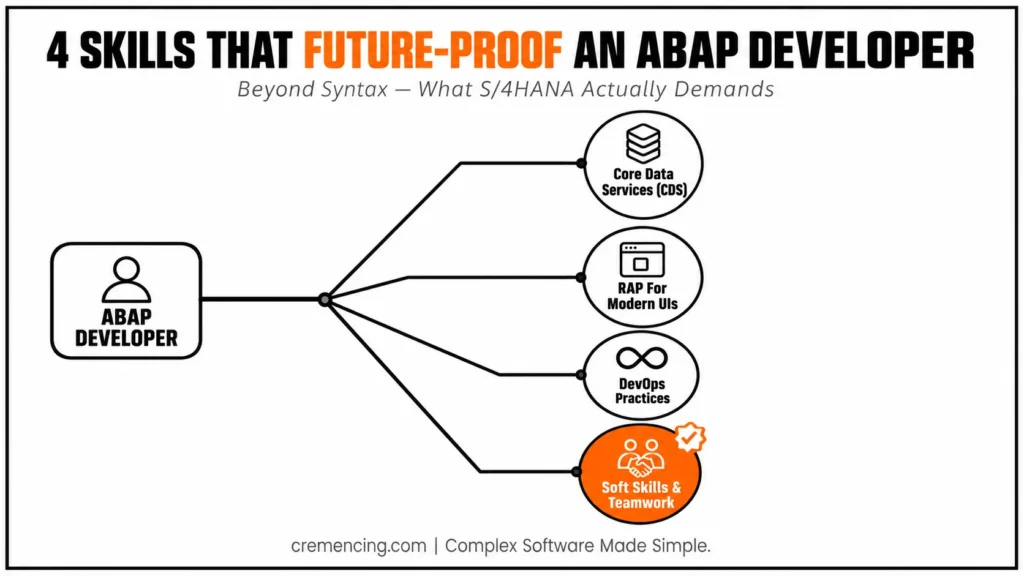
For professional developers, mastering ABAP development in the S/4HANA era goes beyond syntax. It includes:
- Understanding Core Data Services (CDS)
- Using RAP to design UIs for modern applications
- Applying DevOps practices for continuous delivery
- Building soft skills such as teamwork and critical thinking
This mix of technical and business know-how makes ABAP developers valuable assets to digital transformation efforts.
ABAP on HANA
Learning ABAP on HANA is challenging but rewarding. It shortens code-to-data distances, enhances performance, and is fundamental for S/4HANA compliance.
Key Elements in S/4HANA Development
Performance Optimization
- Advanced Data Processing: Reduce data redundancy and simplify logic for faster processing.
- Coding Best Practices: Adopt efficient coding to minimize load and speed up transactions.
- Real-time Analytics: Use real-time reporting for quick business decisions.
Development Simplicity
- Ease of Programming: Simplified codebase for maintainability.
- Abundant Tools: Access to SAP’s development resources.
- Minimize Customization Costs: Use native features to reduce dependencies.
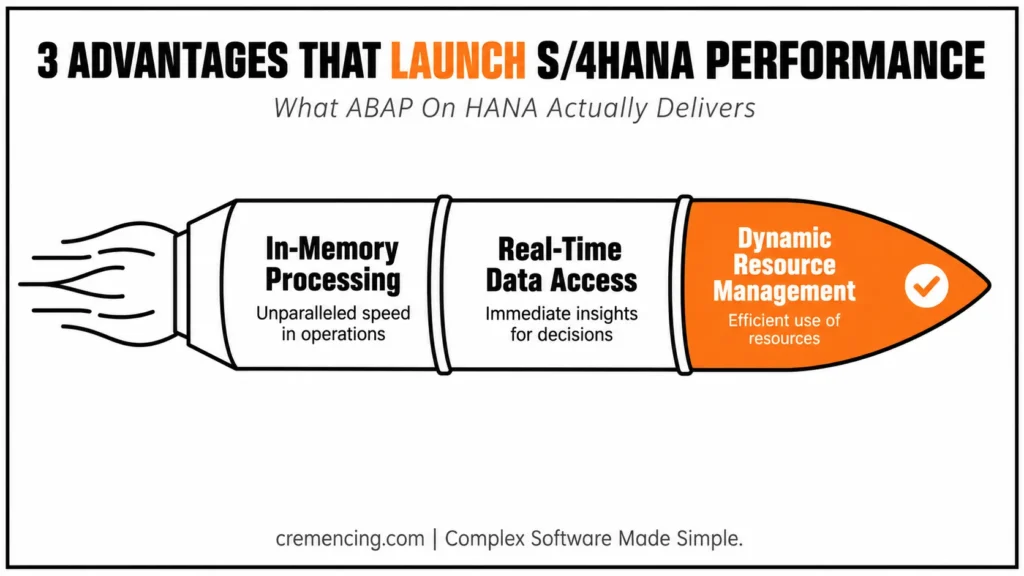
Advantages of Transitioning to S/4HANA using ABAP
| Features | Advantages |
| In-memory Processing | Achieve unparalleled speeds in business operations |
| Real-time Data Access | Immediate insights and analytics for strategic decisions |
| Dynamic Resource Management | Efficient use of resources for optimum performance |
Driving Innovation
With ABAP, SAP HANA supports use cases such as predictive analytics and IoT integration. ABAP acts as the gateway for automation and advanced data processing.
ABAPer: Best Practices and Resources
Keeping Code Clean
- Follow clear naming conventions.
- Use modular code structures.
- Implement strong error handling to avoid runtime issues.
Continuous Learning
Study advanced resources such as SAP Press’s ABAP Development for SAP HANA to stay ahead.
Community Engagement
Join the SAP Community to connect with peers, share knowledge, and gain industry insights.
The Future of ABAP in SAP’s Ecosystem
Despite the move from legacy SAP systems to S/4HANA, ABAP continues to be at the core of many companies’ development strategies. SAP has since brought the language up to date to code to modern standards to support technologies like cloud-native apps, artificial intelligence, and advanced analytics. This flexibility means that ABAP developers are not just supporting systems, but also being innovative. Enhanced with object-oriented programming and RAP, ABAP has been refined and modernized and has become a future-proof language for enterprise applications.
Industry Demand for ABAP Developers
As companies expedite their journey toward SAP S/4HANA, the need for highly skilled ABAP developers has expanded rapidly. Companies need to have guys who know the old, the new, and will shape ABAP towards the future. Developers who can straddle this dichotomy — running legacy applications and concurrently building new, high-performance solutions — are in great demand. This need results to job security, forever learning demand and powerful long-term career potential for ABAP developers.
Best Practices for Long-Term Success
Best Practices for Long-Term Success
Programming in ABAP isn’t just about writing good code. Instead, developers must build habits of continuous improvement, documentation, and frequent engagement with business stakeholders. For instance, they should keep up with SAP’s changing toolset, stay involved in the SAP community, and experiment with new tools such as RAP and CDS views. These are the habits of modern ABAP developers. By doing so, they keep ABAP solutions effective, and their business value remains measurable.
Conclusion
Starting as an ABAP developer in SAP S/4HANA means contributing directly to business improvement. Indeed, for anyone in S/4HANA development, proficiency in ABAP unlocks the full potential of SAP’s tools.
Partner with Cremencing to transform your SAP journey. From ABAP development to SAP S/4HANA integration, we deliver tailored solutions that future-proof your business.
Partner with Cremecing to transform your SAP journey. From ABAP development to SAP S/4HANA integration, we deliver tailored solutions that future-proof your business
Frequently Asked Questions
What is ABAP Development for SAP S/4HANA?
It is the process of building tailored S/4HANA system extensions with SAP’s newest ABAP release.
Why is ABAP important for S/4HANA?
ABAP improves application performance and supports real-time data processing in S/4HANA.
Why develop in SAP ABAP on HANA?
ABAP on HANA leverages in-memory technology for faster analysis, queries, and reporting.
What are the best practices for ABAP on HANA?
- Optimize code for in-memory execution
- Use CDS views and the RAP model
- Keep modular and scalable coding standards
What is the difference between classic ABAP and ABAP on HANA?
Classic ABAP pulled data to the application server and processed it there. ABAP on HANA pushes data-intensive logic down to the database using CDS views and optimized SQL, which makes processing much faster.
What is the ABAP RESTful Application Programming Model (RAP)?
RAP is SAP’s modern framework for building transactional, service-based apps and Fiori-ready services. It is built on CDS and supports clean, upgrade-safe extensions.
What are Core Data Services (CDS) views in ABAP?
CDS views define data models at the database level. They let developers join, filter, and calculate data close to the data, which improves performance and reuse.
Is ABAP still relevant for S/4HANA developers?
Yes. ABAP remains central to S/4HANA custom development and extensions. Demand is strong for developers who know both legacy code and modern ABAP.
What skills does an ABAP developer need for S/4HANA?
Developers need strong ABAP syntax, object-oriented programming, CDS, and RAP skills, as well as knowledge of SAP modules and DevOps practices. Good communication with business stakeholders also helps.
How does ABAP support clean core extensibility in S/4HANA?
Developers use extension mechanisms such as RAP, CDS views, and released APIs instead of modifying standard SAP code. This keeps the core clean, makes upgrades easier, and lowers long-term maintenance costs.