The Clean Core Promise And Why It Is Hard To Keep For So Many Corporates
But inside, many SAP leaders are aware of the uncomfortable truth.They cannot lay a finger on their SAP systems. Years of added functionality, bespoke code, moreover integrations with little or no documentation and “get it working quick” solutions have now created a leviathan far worse than just complexity .Furthermore, this is SAP Legacy Technical Debt.
All SAP roadmap presentations eventually get to one irresistible sales pitch. Stay innovation-ready. And that SAP Technical Debts insidiously standing in the way of any base-level, practical road to Clean Core.
Upgrade faster.Reduce risk. This is not a tooling issue. It’s not a skills problem. It’s a structural one.
The Connection between SAP Legacy Technical Debt & Clean Core is now critical for CIOs, enterprise architects and safely the transformation owners at Fortune 1000 companies that want to modernize and not wreck their business.
Why Technical Debt from SAP Legacy Screams Strategic Liability
Technical Debt is a term commonly associated with engineering—outdated code, outmoded enhancement or approach to doing something.
In fact, it’s the business risk multiplier.
Legacy debt shows up as:
- Fear of upgrades
- Over-testing before every change
- Dependence on specific individuals
- High cost of ownership
- Delayed innovation
And the more you leave such a debt untended, the worse it becomes.
Clean Core efforts are stymied not because leaders don’t get it but because the system can’t bear to support the discipline that Clean Core demands.
What ‘Clean Core’ Really Demands (Beyond the Buzzword)
Clean Core is no prohibition of customization. It’s one of governance and architecture.
What Clean Core boils down to is:
- Minimal modification of SAP standard
- Distinct separation of core and extensions
- Upgrade-safe development practices
- Transparent ownership of change
SAP Legacy Technical Debt clearly violates all of these tenets.
If one sticks custom logic deep inside core tables, undocumented exits or heavily wired-in integrations, Clean Core is then only a dream goal and not an achievable strategy.
How SAP Legacy Technical Debt Acts as Obstacle to Clean Core Migration
Custom code becomes lock-in by its nature; a structural lock-in.
Many legacy enhancements:
- Directly modify standard SAP objects
- Depend on obsolete data structures
- Are business-critical but poorly understood
Taking them out or re-engineering them smacks of danger and so they remain.
This creates a paradox:
You wish Clean Core were lower risk, but seven-figure legacy debt makes change feel even scarier to you than staying stuck.
Cost of Testing Increases Exponentially with Every Iteration
Legacy Technical debt adds to the regression risk.
As a result:
- Every upgrade requires massive testing
- Users lose confidence in releases from business perspective
- IT teams take the concept of freeze periods too far
Clean Core and predictable upgrades but the legacy debt makes that a joke.
Integration Coupling Destroys Core Boundaries
In legacy SAP landscapes:
- “Integrations are part and parcel of core logic.”
- Difference in one place affects randomly
- Ownership is fragmented
Clear separation is what Clean Core relies upon.
Legacy integrations erase those lines.
Tribal Knowledge Replaces Architecture
Absence of documentation and scattered logic:
- The system is known only to few
- Decisions become fear-driven
Clean Core is “politically unsafe”.
This is one of the most underappreciated aspects of SAP Legacy Technical Debt.
Why So Many Good Clean Core Initiatives Just Quietly Failed
The point at which most Clean Core efforts break down is not during planning, but execution.
Common patterns include:
- Announcement of Clean Core without solving legacy debt
- Shifting “as is” custom code to S/4HANA
- Developing sibling extensions that still rely on the dirty core logic
- Postponing remediation “until after go-live”
The result?
- A contemporary system built on old foundations
- Clean Core in name
- Legacy Core in reality
Executives often ask:
“Can’t we move in first and clean up later?”
Technically, yes. Strategically, it’s dangerous.
SAP Legacy Technical Debt & Clean Core cannot be separated.
Every unresolved debt item:
- Increases future remediation cost
- Limits architectural options
- Reduces transformation ROI
Debt you ignore is not gone, it’s just buried further in the future.
Here’s What a Real Clean Core Journey Is Like
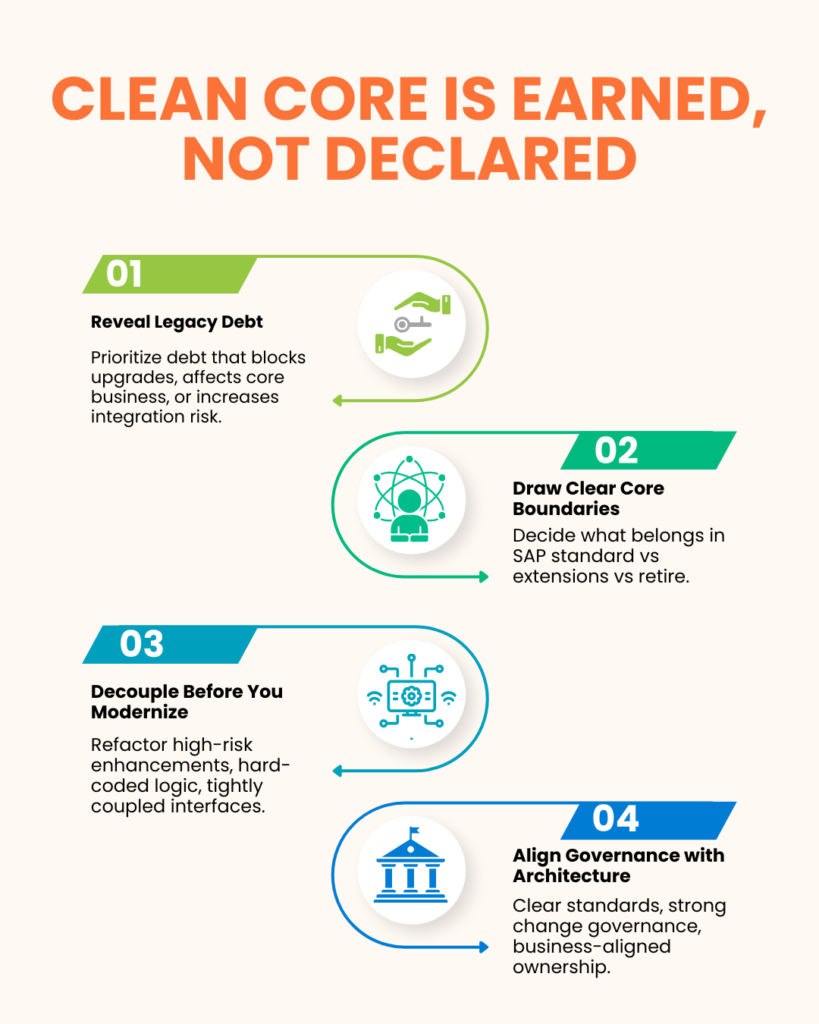
It is not the place to start for successful organizations. They begin with visibility and prioritization.
Reveal Legacy Debt
Begin by making the legacy debt visible.
All SAP Technical Debtis not equally important.
Focus on:
- Debt that blocks upgrades
- Debt related to core business functions
- Debt that increases integration fragility
Step 2: Drawing Clear Core Boundaries
Clean Core requires explicit decisions:
- What belongs in SAP standard
- What belongs in extensions
- What must be retired
Uncertainty is the enemy of Clean Core.
Decouple before you modernize
Refactor or isolate:
- High-risk enhancements
- Hard-coded logic
- Tightly coupled interfaces
This mitigates risk prior to, but not after, migration.
Step 4: Aligning Governance With Architecture
Clean Core is sustained by:
- Clear development standards
- Strong change governance
- Business-aligned ownership
Without governance, the legacy debt will come back — fast.
Clean Core is Actually Not All About Less Customization — It’s Better Customization
Clean Core does not mean:
- No differentiation
- No innovation
- No extensions
It means:
- Differentiation without breaking the core
- Innovation without upgrade fear
- Extensions without long-term debt
Governing SAP Legacy Technical Debt & Clean Core in combination makes that possible. For more insights read our Blog on SAP Integration Governance Ownership
What CIOs and SAP Leaders Need to Be Asking Now
Leadership needs to ask:
- What is our legacy debt that’s stopping the SAP upgrade?
- Where is custom logic in the core?
- Which improvements truly bring value to the business?
- What debt have we decided to take on, and why?
If the answers aren’t clear, Clean Core is aspirational, not actionable.
The Competitive Cost of Inaction
What happens if i keep putting off kicking our can of SAP Legacy Technical Debt down that road
- Upgrade slower
- Pay more for maintenance
- Miss innovation windows
- Accept instability as normal
Meanwhile, competitors with cleaner cores:
- Adopt new SAP capabilities faster
- Reduce operational risk
- Scale with confidence
And Clean Core is more than technical hygiene it’s competitive positioning.
Final Thought: Clean Core Is Not Declared, It’s Earned
You cannot mandate Clean Core.
You need to make it likely.
As long as SAP Legacy Technical Debt is not recognized, prioritized, and reduced, Clean Core will be a slide… Not reality.
The issue is not to deal with legacy debt.
It’s whether or not you do it intentionally or allow it to dictate your future.
If Clean Core is somewhere on your SAP roadmap, but the complexity of legacy environments makes change seem risky, it’s time to have a new conversation.
Start by:
- Finding SAP Legacy Technical Debt blocking Clean Core
- Understanding where risk truly lives
- Building a realistic roadmap for modernization that holds the business harmless
Find out how an organized SAP technical debt and Clean Core readiness assessment can help clear the smoke and avoid common misconceptions.