
Everything You Need to Know for Project Success
SAP EPPM helps enterprises connect portfolio planning, project execution, resource management, and commercial project control within their SAP landscape. Instead of managing these activities across disconnected systems, organizations can use SAP’s EPPM capabilities to coordinate projects, monitor costs and resources, and align execution with broader business priorities.
Organizing work across projects, departments, geographies, and teams can be challenging. However, the EPPM environment is designed to address this challenge by providing an integrated platform to plan, manage, and analyze portfolios and projects.
Whether you are responsible for IT rollouts, product development, or infrastructure upgrades, SAP EPPM can help you:
Align projects with strategic goals
Streamline workflows
Optimize resource allocation
What is SAP EPPM?
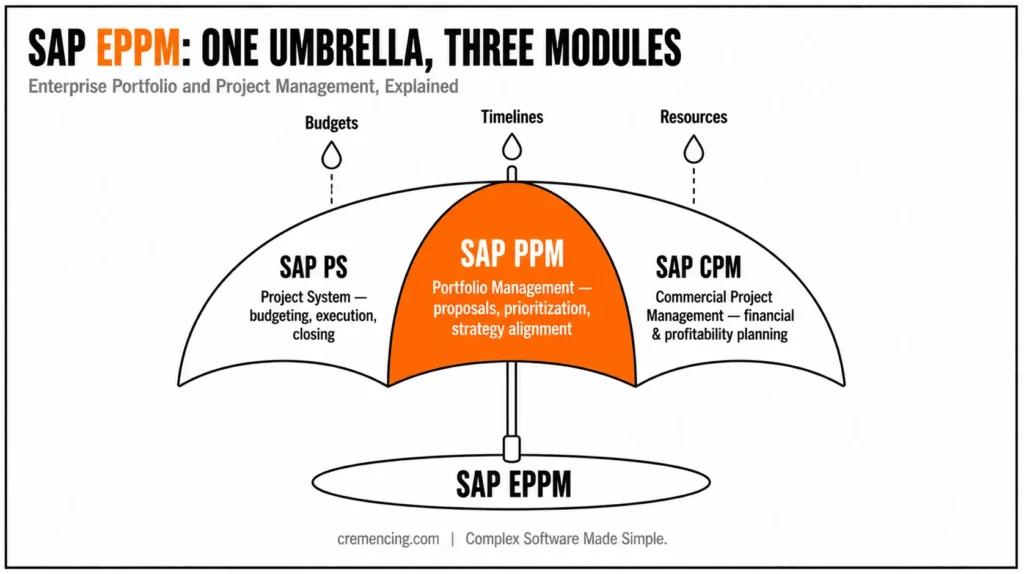
In SAP S/4HANA on-premise, the EPPM environment refers to an integrated set of project and portfolio capabilities covering areas such as Project System, Portfolio and Project Management, and Commercial Project Management. Exact functionality depends on the SAP S/4HANA release and deployment model.
| Module | Purpose |
| SAP PS (Project System) | Manages individual projects with budgeting, execution, and closing capabilities. |
| SAP PPM (Portfolio and Project Management) | Manages project proposals, prioritization, and alignment with strategy. |
| SAP CPM (Commercial Project Management) | Provides financial and commercial planning tools for project profitability. |
SAP EPPM enables organizations to:
Key Benefits of SAP EPPM
SAP EPPM enables organizations to manage projects more consistently across teams. For example, organizations can use it to:
- Centralize management: Keep project information in a connected SAP environment.
- Improve planning: Support forecasting, scheduling, budgeting, and execution.
- Strengthen analytics: Use project and portfolio information to monitor performance and support decisions.
- Automate workflows: Configure approvals and business processes around organizational requirements.
- Connect business processes: Integrate project activities with relevant S/4HANA finance, procurement, logistics, and other processes.
Who Uses SAP EPPM?
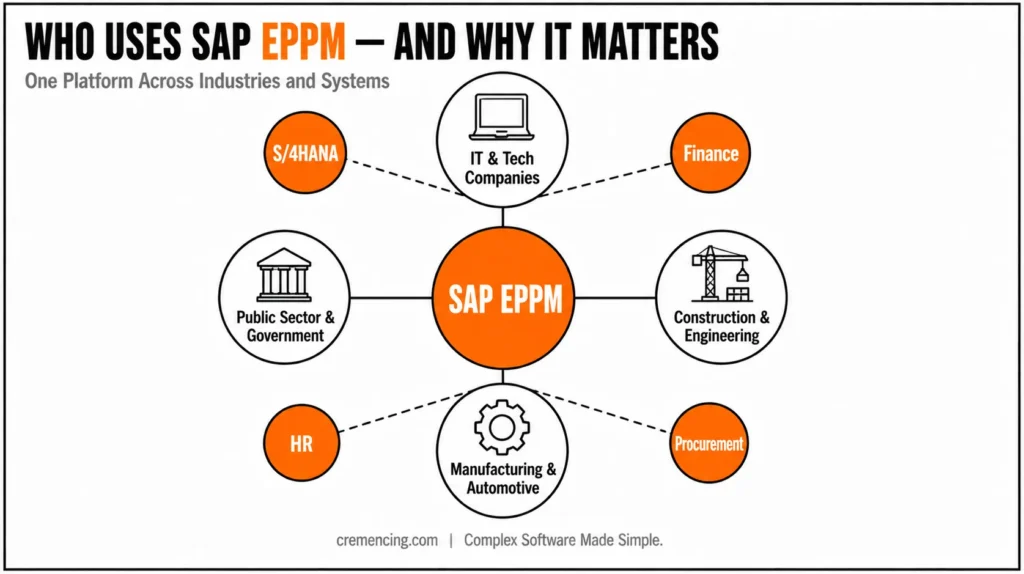
SAP EPPM is used by:
- IT & Tech Companies
- Construction & Engineering
- Manufacturing & Automotive
- Public Sector & Government
SAP EPPM vs SAP PS vs SAP PPM
| Feature | SAP PS | SAP PPM | SAP EPPM |
| Scope | Single Project | Portfolio-Level | Complete Lifecycle |
| Analytics | Basic | Moderate | Advanced + AI Support |
| Resource Planning | Yes | Yes | Enhanced, Centralized |
| Integration | High (ERP) | Medium | High (S/4HANA, Fiori) |
The EPPM environment combines all major capabilities into one integrated solution.
Additional Technologies Inside SAP EPPM
Additional Technologies Inside SAP EPPM
Several SAP technologies support the broader EPPM environment. For example:
- SAP Fiori: Provides role-based interfaces for supported project and portfolio processes, including monitoring, planning, and approvals.
- SAP S/4HANA: Provides the enterprise platform where project processes can interact with financial, procurement, logistics, and other business processes.
- ABAP Platform: Supports appropriate custom enhancements and extensions based on the system’s deployment model and extensibility requirements.
- SAP Business Workflow: Supports business approvals and workflow automation where applicable.
Together, these technologies help connect project processes with the wider SAP landscap
Why Choose Cremencing.com for SAP Custom Development?
At Cremencing Solutions, we specialize in:
- Building custom SAP EPPM extensions
- Developing custom workflows and dashboards
- Integrating the EPPM landscape with third-party tools
- Offering SAP staff augmentation for project success
Explore Our SAP Custom Development Services
Use Cases
- Aligning product launches with global marketing strategy
- Managing engineering and construction milestones
- Integrating procurement and budgeting into project plans
- Using machine learning to improve project forecasting
Conclusion
SAP EPPM brings portfolio planning, project execution, and commercial project control into a connected SAP environment. More importantly, its value comes from how these capabilities interact with financial, procurement, resource, and other business processes. This connected approach can give project teams greater visibility into costs, resources, schedules, and portfolio priorities.
Ultimately, successful EPPM implementation depends on matching the right capabilities to the organization’s project processes and SAP landscape. Standard functionality should remain the starting point, while integrations, extensions, and custom development should address requirements that standard capabilities do not cover. With the right implementation approach, organizations can build an EPPM environment that supports both current project needs and future business requirements.
Contact Cremencing Solutions
Wanting to implement or set up SAP EPPM for your organization? Expertise in SAP Custom Development. You may be seeking support of a specific bespoke nature for your industry, processes, or desired level of performance.
Frequently Asked Questions (FAQs)
What is SAP EPPM?
SAP EPPM is a suite of tools from SAP that helps enterprises manage portfolios and projects efficiently, from budgeting to execution.
What is EPPM?
Enterprise Portfolio and Project Management (EPPM) is the discipline of centrally managing an organization’s projects.
What is the difference between SAP PS and EPPM?
SAP PS handles individual project tracking, while SAP EPPM offers a broader, integrated portfolio and resource management system.
What is the difference between PPM and EPPM?
SAP PPM is part of SAP EPPM. EPPM covers additional components like SAP PS, CPM, and broader analytics tools.
What is SAP EPPM Certification?
It’s a professional course offered by SAP to validate your ability to configure and implement EPPM in SAP S/4HANA.
What are SAP EPPM jobs?
Typical roles include SAP EPPM Consultant, SAP PS Specialist, Project Manager, and Integration Developer.